Couple Deep Tissue
Massage Dubai.
Two licensed therapists, two tables, and sustained firm work through the knots a lighter hour never reaches — delivered to your home across Dubai.
What The Deep Tissue
Session Actually Does.
Slow sustained pressure, forearm and elbow work, cross-fibre technique — the therapeutic session for tension that keeps coming back.
Sustained Pressure
Slow static holds into the tight band rather than gliding past it — the technique's whole method.
Static holdsForearm Elbow
Broader, heavier tools than thumbs — more reach, more control, and no fatigue mid-session.
Deeper reachCross-Fibre Work
Pressure applied across the muscle's grain, addressing the adhesion rather than working around it.
Cross-grainRegion Focused
Back, shoulders, neck, hips, calves — the problem areas get the hour, not the whole body equally.
TargetedYour Pressure
Firm is the point, but firm is a conversation — set per table and adjusted by feedback throughout.
Set per tableSame Start
Both partners begin and finish together — two therapists, one clock, regardless of technique.
SynchronizedHonest Soreness
Next-day tenderness is normal after real deep work, and we tell you before rather than after.
Told upfrontSwedish Pairing
Most couples split it — deep tissue one table, Swedish the other, same price, same hour.
Mixed techniqueStraight Pricing For
Both Partners Together.
One figure covers both partners with everything carried to your door — tables, linens, oils, two therapists. Quoted before you book, matched at the door, no additions afterwards.
The targeted session — focused work on two or three problem regions rather than the whole body.
Book 60 minThe deep tissue standard — enough time to work properly and still finish the body's remainder.
Book 90 minThe full therapeutic hour doubled — chronic areas given real time, the session serious work deserves.
Book 120 min- Two DHA-licensed therapists every booking
- Two tables, linens, towels, oils
- Pressure set separately per partner
- Both tables starting the same moment
- Honest guidance before the session starts
- The price quoted is the price
Name The Problem Area
And Both Tables Rise.
Tell us where the tension actually lives, give the address and hour, and two therapists arrive as one with everything needed.
-
1
Two minutes
Name The Area
Shoulders, lower back, neck, hips — the therapist plans the hour around what you actually flag.
-
2
Within the hour
Set Your Pressure
Firm has a range, and yours is set at the start then adjusted by your feedback throughout.
-
3
Ten minutes
Give Address Hour
Building or villa with the area, plus the time that works — the window quoted honestly.
-
4
Your hour
Relax At Home
Both therapists arrive together, the tables rise, one start, one finish, gone in ten minutes.
Most couples worry they do not have the space. Almost every Dubai home does — a living room with the coffee table pushed aside is plenty.
- About 3 × 3 metres of clear floor — a living room or bedroom both work
- One power socket for a small speaker and a towel warmer
- Building access — tell us the rules and we handle the rest
- Nothing else. Tables, linens, towels, oils and music all come with us
What couples say
after the room goes quiet.
We booked this for our anniversary and honestly I expected it to feel awkward — two strangers, two tables, our living room. It wasn’t like that at all. They arrived together, moved the coffee table themselves before I could offer, and had everything set up while I was still making tea. Same…
Couple Deep Tissue Massage in Dubai
Deep tissue is the session people book when a lighter massage stopped being enough. The knot in the right shoulder that comes back every Wednesday. The lower back that tightens by Thursday afternoon. The neck that a desk, a commute and a phone have between them turned into something permanent. Swedish feels pleasant over that kind of tension; deep tissue actually works into it.
A couple deep tissue massage at home in Dubai means two DHA-licensed therapists arriving together, two tables, and sustained firm work delivered on the same clock — with the pressure set independently for each table, because deep tissue for one partner and something gentler for the other is the most common couple booking we take.
This page covers what deep tissue genuinely involves, how firm is firm, who it suits, who should book something else, the soreness question answered honestly, and how the couple format handles two people wanting different things at the same hour.
What Deep Tissue Massage Actually Is
Deep tissue works the deeper layers of muscle and the fascia around them, using slow sustained pressure rather than the gliding rhythm of a Swedish session.
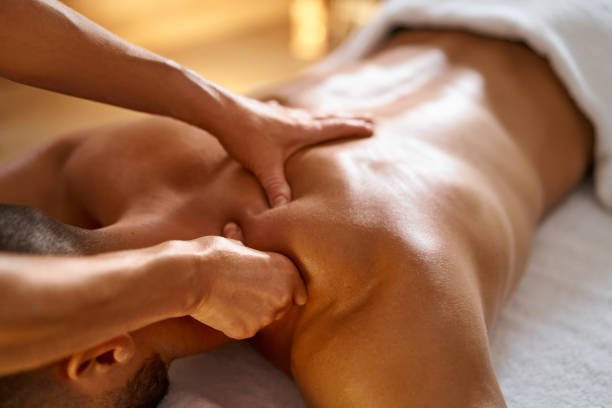
Sustained static pressure. The therapist finds the tight band and holds pressure into it, waiting for the tissue to release rather than stroking past it. This is the technique’s core and the reason it feels entirely different from anything lighter.
Forearm and elbow work. Thumbs fatigue and lack reach. Forearms and elbows give broader, heavier, more controllable pressure and let the therapist maintain it for as long as the tissue needs.
Cross-fibre friction. Pressure applied across the muscle’s grain rather than along it, addressing the adhesions and scar tissue that keep a problem area coming back.
Stripping. Slow deliberate passes along the length of the muscle, following the fibre line, working through the band from one end to the other.
Trigger point pressure. Direct sustained pressure on the specific knots that refer pain elsewhere — the shoulder point that sends an ache into the neck, the hip point that lights up the lower back.
The session is region-focused rather than full-body. Sixty minutes properly covers two or three problem areas. Trying to do a full body in deep tissue in an hour produces a firm Swedish, not a deep tissue session — and we will say so at booking rather than pretend otherwise.
How Firm Is Firm
The honest version, because this is where expectations most often mismatch.
Deep tissue should feel like productive discomfort — a pressure you can breathe through, that feels like it is reaching something, that you would describe afterwards as intense rather than painful. That is the working range and that is where the technique does its job.
It should not feel like pain you have to brace against. Bracing is counterproductive: a muscle guarding against pressure cannot release under it. If you are gripping the table, holding your breath or tensing away from the hands, the pressure has gone past useful and into wasted. Say so. Therapists expect it, adjust immediately, and the session improves.
Firm is a range, not a setting. Your firm and your partner’s firm are different numbers, and both are set independently at the start of the session and adjusted throughout by feedback. Telling the therapist “a little less on that spot, more on the one below it” mid-session is exactly how the hour is supposed to work.
The Soreness Question, Answered Honestly
Next-day tenderness after genuine deep tissue work is normal and common. It usually feels like the day after a hard gym session — a dull ache in the worked area, most noticeable the morning after, fading over a day or two.
What helps: water, a warm shower, gentle movement rather than sitting still, and not scheduling anything physically demanding for the next day if the session was heavy.
What is not normal: sharp pain, bruising beyond faint tenderness, numbness, tingling, or soreness that worsens rather than fades after forty-eight hours. That means the pressure went too far, and it should be mentioned so the next session is calibrated differently.
Being told this before the session rather than after is part of the service. A therapist who promises deep work with no possible after-effect is either not going deep or not being straight with you.
Why Couples Book Deep Tissue as a Split
The most-booked couple massage in Dubai is not two matching sessions. It is deep tissue on one table and Swedish on the other — and the format was built for exactly this.
One partner carries a specific problem: the desk shoulder, the driving back, the training load. The other wants the restful hour. Booking separately would mean two appointments, two prices and two different times. The couple format gives both, at the same hour, in the same room, for one price that covers the pair regardless of which techniques they pick.
The therapists arrive prepared for both. The pressure on one table has nothing to do with the pressure on the other. Both sessions still start and finish together.
Other common splits: deep tissue beside reflexology when one partner’s day lives in their feet; deep tissue beside Thai when one wants pressure and the other wants stretch; deep tissue beside aromatherapy when one wants the work and the other wants the wind-down.
Who Deep Tissue Suits
Desk-bound weeks that have become desk-bound years — the upper back, shoulder and neck pattern
Long commutes, where the lower back and hips take the hours
Anyone with a specific recurring knot rather than general tiredness
Manual and standing work: lifting, standing shifts, trades, warehouse and clinical floors
Gym and training loads, where the tightness is earned and specific
Old tension patterns that lighter massage relieves for a day and no longer
Who Should Book Something Else
A first massage. Start with Swedish. Deep tissue as a first experience often reads as unpleasant rather than therapeutic, and there’s no need to begin at the deep end.
A purely restful evening. If the goal is to switch off and possibly fall asleep, deep tissue is the wrong tool. Swedish, aromatherapy or hot stone all do that far better.
Pregnancy. The prenatal-adapted session is deliberately not deep tissue — side-lying, lighter pressure, abdomen avoided, second trimester onward with a doctor’s approval.
Acute injury. Fresh strains, recent surgery, active inflammation: the area waits until a doctor clears it. Deep pressure on acute tissue makes things worse, not better.
Athletic recovery specifically. Sports massage overlaps with deep tissue but is briefed differently — by discipline, by training phase, and by whether you’re recovering or preparing. If that’s the goal, book sports.
Safety Notes and When to Postpone
Blood thinners and clotting disorders: deep pressure increases bruising risk. Mention it at booking — the session adapts to moderate pressure or we suggest a different technique.
Uncontrolled high blood pressure, heart conditions, or recent cardiac events: mention at booking; a doctor’s clearance may be the right first step.
Recent surgery, fractures, or acute injury: the area is avoided until cleared. The rest of the body is usually still workable.
Osteoporosis or fragile bone conditions: deep tissue is generally not the right technique; Swedish at light-to-moderate pressure is.
Varicose veins, skin conditions, open wounds, serious sunburn: the affected area is avoided, and significant sunburn postpones entirely.
Fever or active infection: postpone.
Any diagnosed condition or current medication: say so at booking. The session adapts, and where clearance is genuinely needed, we say so plainly rather than proceeding.
We are a licensed home massage service, not a medical provider. Deep tissue massage relieves muscular tension; it does not treat, diagnose or cure medical conditions, and nothing here is medical advice. For persistent pain, see a doctor or physiotherapist first.
Session Lengths
Sixty minutes is the targeted session: two or three problem regions worked properly, with the rest of the body left alone. This is the honest use of the hour, and it is the format most couples book on a weeknight.
Ninety minutes is the deep tissue standard. Enough time to work the problem areas thoroughly and still give the rest of the body a passing Swedish-style finish. If deep tissue is the reason you’re booking, this is the length worth choosing.
One hundred and twenty minutes is for chronic areas that need real time, or for couples who want the therapeutic work and the unhurried evening both.
What to Expect During the Session
Your therapist will ask where the tension is before starting — be specific. “Right shoulder blade, and the left side of my lower back” is more useful than “everywhere.”
The session usually opens with warming Swedish-style strokes. Cold muscle does not release under pressure, so the first several minutes are preparation rather than the deep work itself. This is not the therapist going easy.
Once the tissue is warm, the pressure builds gradually into the flagged areas. Breathing matters: slow breaths out as pressure increases help the muscle release. Holding your breath does the opposite.
Speak up during the session. More, less, move on, stay there — all normal, all expected, none of it rude.
The session closes with lighter strokes to settle the worked areas before you get up.
Pricing
One figure covers both partners. It includes both therapists, both tables, all linens and towels, the oils and the travel. It is quoted in the message before you book and matched at the door.
There is no surcharge for choosing deep tissue over a lighter technique, no per-therapist multiplication, no travel fee by area, and no late-slot premium. If one partner takes deep tissue and the other takes Swedish, the price is unchanged.
Coverage Across Dubai
Couple deep tissue runs to every area we serve — the coastal belt, the central districts, the villa belt, the eastern corridor, old Dubai’s quarters, the southern reach and into Sharjah.
Arrival windows vary honestly by distance: coastal and central districts inside about an hour, villa belt and eastern corridor around an hour and a quarter, far southern communities and Sharjah at an hour and a half with half a day’s notice. Each area page quotes its own window. The price does not change with the address.
Frequently Asked Questions — Couple Deep Tissue Massage Dubai
Will it hurt?
It should feel intense but breathable — productive discomfort, not pain you brace against. If you’re gripping the table, the pressure has gone too far and the therapist will ease off the moment you say so.
Will we be sore afterwards?
Often mildly, for a day or two, like the day after a hard workout. Water, a warm shower and gentle movement help. Sharp pain or worsening soreness is not normal and should be mentioned.
Can one of us have deep tissue and the other something gentler?
That’s the most-booked couple session in Dubai. Pressure is set per table, both still start and finish together, and the price is the same.
Is sixty minutes enough?
For two or three focused problem areas, yes. For deep tissue plus a full-body finish, book ninety — that’s the length the technique is really designed around.
How is it different from a firm Swedish?
Swedish stays gliding and rhythmic even when firm. Deep tissue holds sustained static pressure into a specific band and works across the fibre. Different method, different result.
Can I have deep tissue while pregnant?
No — the prenatal-adapted session is deliberately lighter: side-lying, moderate pressure, abdomen avoided, second trimester onward with a doctor’s approval. First trimester is declined.
What should we tell the therapist?
Exactly where the tension lives, any diagnosed conditions or medications, and your pressure preference. Specific beats general every time.
Should we do anything before or after?
Before: nothing special, though a warm shower helps. After: water, gentle movement rather than sitting still, and nothing physically demanding the next day if the session ran heavy.
Book Your Couple Deep Tissue Massage in Dubai
Name the area that actually bothers you, choose the pressure, decide whether the second table takes deep tissue too or something gentler, and give us the address and hour. Two licensed therapists arrive together with everything the session needs, both tables rise in your own room, and the work that a lighter hour never quite reached finally gets done — for one of you or both, on the same clock, at the price quoted before you booked.
Real couples,
real evenings.
Reading for
the two of you.
Hello world!
Welcome to WordPress. This is your first post. Edit or delete it, then start writing!
Read article