Couple Sports
Massage In Dubai
Two licensed therapists, two tables, and targeted work briefed by your sport and your training week — recovery delivered to your door across Dubai.
What The Sports Session
Actually Works On
Region-specific stripping, friction and mobility work, briefed by discipline, training phase and how far out the next event is.
Briefed By Sport
Running, cycling, padel, swimming, lifting — the session is planned around what you actually do.
60 min · Sport-SpecificRegion Focused
Legs, hips, shoulders or back — the working load gets the hour, not the whole body equally.
60 min · Targeted RegionStripping Work
Slow deliberate passes along the muscle fibre, working the length of the band end to end.
60 min · StrippingCross-Fibre Friction
Pressure across the grain where adhesion has built up — the technique's therapeutic core.
60 min · Cross-FibreTiming Matters
Pre-event, post-event or mid-block — each needs different pressure, and the brief decides.
60 min · By Training PhaseMobility Included
Assisted stretching and range work folded in — recovery is not only about pressure.
60 min · Assisted StretchingSame Start
Both partners begin and finish together — two therapists, one clock, regardless of technique.
60 min · SynchronizedPartner Split
One trains, one doesn't — sports one table, Swedish the other, same hour and price.
60 min · Mixed TechniqueStraight Pricing
For Both Partners Together.
One figure covers both partners with everything carried to your door — tables, linens, towels, oils, two therapists. Quoted before you book, matched at the door.
The targeted session — two or three working regions handled properly, the standard recovery booking.
Book 60 minThe full version — the working load plus the compensating regions, and mobility work throughout.
Book 90 minThe block-end session — everything worked thoroughly, for the week after a heavy training period.
Book 120 min- Two DHA-licensed therapists every booking
- Two tables, linens, towels, oils
- Session briefed by sport and timing
- Honest guidance on pressure and soreness
- Both tables starting the same moment
- The price quoted is the price
Tell Us The Sport
And The Race Date
Name what you train, where it hurts and when the next event is — the session is planned around all three.
-
1
Two minutes
Name Your Sport
Running, cycling, padel, swimming, gym — the discipline determines which regions carry the load.
-
2
Within the hour
Flag The Timing
Race in three days or eight weeks out — the pressure changes completely between them.
-
3
Ten minutes
Point To Problems
The calf that tightens, the shoulder that catches — specifics beat general every single time.
-
4
Your hour
Relax At Home
Both therapists arrive together, the tables rise, one start, one finish, gone in ten.
Most couples worry they do not have the space. Almost every Dubai apartment does — a living room with the coffee table pushed aside is plenty.
- About 3 × 3 metres of clear floor — a living room or bedroom both work
- One power socket for a small speaker and a towel warmer
- Building access — tell us the security rules and we handle the rest
- Nothing else. Tables, linens, towels, oils and music all come with us
What couples say
after the room goes quiet.
We booked this for our anniversary and honestly I expected it to feel awkward — two strangers, two tables, our living room. It wasn’t like that at all. They arrived together, moved the coffee table themselves before I could offer, and had everything set up while I was still making tea. Same…
Couple Sports Massage in Dubai
Sports massage is deep tissue with a brief. The techniques overlap heavily — sustained pressure, stripping, cross-fibre friction — but the session is planned around what you actually do, which muscles carry that load, what’s compensating for what, and how far out your next event is. The same tight calf gets worked completely differently three days before a race and three days after one.
A couple sports massage at home in Dubai means two DHA-licensed therapists arriving together, two tables, and both sessions running on the same clock. It is also, very often, a split booking: one partner trains and the other doesn’t, so one table takes sports work and the other takes something entirely gentler — for one price, at the same hour.
This page covers what the session involves, how the brief changes it, the sport-by-sport patterns we see most in Dubai, the timing question around events, and the honest limits of what massage does for performance.
What Sports Massage Actually Is
The technical vocabulary overlaps with deep tissue, and the difference is in application.
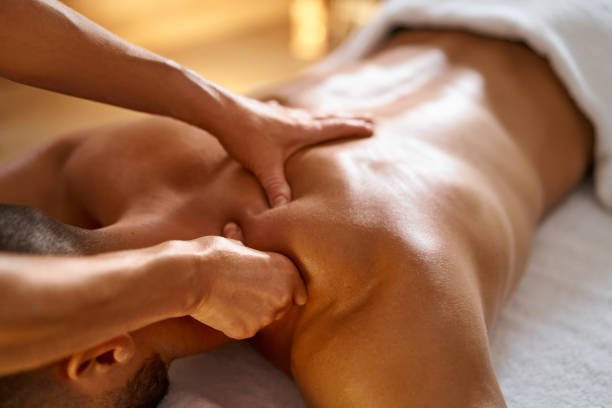
Stripping. Slow deliberate passes along the length of the muscle, following the fibre line from origin to insertion. The primary tool for working a band that has tightened under repeated load.
Cross-fibre friction. Pressure applied across the muscle’s grain rather than along it, addressing the adhesions that build where tissue has been repeatedly stressed and repaired.
Compression. Rhythmic broad pressure through the muscle belly, used to warm tissue and increase circulation before finer work.
Trigger point release. Sustained pressure on specific points that refer pain elsewhere — the glute point that lights up a hamstring, the shoulder point that sends an ache down an arm.
Assisted stretching and range work. Folded in throughout rather than tacked on. Recovery is as much about restoring range as releasing tension, and a sports session that only presses is doing half the job.
Flushing strokes. Long directional work toward the heart, used through the legs particularly, to move fluid and metabolic waste out of worked tissue.
How the Brief Changes the Session
This is the part that separates sports massage from a firm generic hour.
By sport. A runner’s load sits in calves, hamstrings, hip flexors, glutes and the band down the outside of the thigh. A cyclist’s sits in quads, hip flexors, lower back and the neck and shoulders from the riding position. A swimmer’s sits in shoulders, lats and upper back. A padel or tennis player’s sits in one shoulder, one forearm and the rotational muscles through the trunk. A lifter’s depends entirely on the split.
By what’s compensating. The tight calf is often not the problem — it’s covering for a weak glute or a stiff ankle. A decent sports session works the compensating chain rather than just the loudest complaint.
By timing. Covered in full below, but briefly: heavy work three days before a race is a mistake, and heavy work the day after a hard race is a different mistake.
By training phase. Mid-block, tapering, off-season and returning from a break all warrant different pressure and different focus.
Tell us the sport, the timing and where it actually hurts. Those three sentences change the hour completely.
Timing Around Events
The most useful section on this page.
More than a week out. Full sports work, firm pressure, everything on the table. This is where the real therapeutic work happens and where soreness afterwards is acceptable because you have time to recover from it.
Three to seven days out. Moderate work. Problem areas addressed, but nothing aggressive enough to leave you sore into the event.
Forty-eight hours or less before an event. Light flushing work only — circulation, gentle mobility, nothing deep. Deep work this close to a race is the single most common self-inflicted mistake in amateur sport. If you book us two days before a marathon and ask for heavy pressure, we will explain why we’re not going to.
Immediately after an event. Very light. The tissue is inflamed and damaged; deep pressure on it makes recovery slower, not faster. A gentle flushing session in the twenty-four hours after a hard race is genuinely useful; anything deeper is counterproductive.
Two to four days after an event. This is the good window. The acute inflammation has settled and the tissue responds well to proper work. If you book one session around a race, book it here.
The Dubai Patterns We See Most
Al Qudra and the cycling track. Long weekend rides through the cool months produce a very consistent pattern: quads, hip flexors, lower back and a neck that held a riding position for four hours. The century-ride recovery is one of our most-booked sports sessions from November onward, and it goes in the diary for the Sunday evening.
Running. The waterfront routes, the park loops and the winter race calendar. Calves, hamstrings, the lateral thigh and the hips. Race-season bookings cluster around the same weekends every year.
Padel. The city’s fastest-growing sport and the one producing the most asymmetric complaints we see — one shoulder, one forearm, one side of the trunk. The pattern is distinctive enough that therapists recognise it before being told.
Swimming. Shoulders, lats, upper back, neck. Steady year-round and concentrated in the coastal districts.
Gym and strength training. Entirely dependent on the split, which is why we ask. A session planned around a push-pull-legs routine looks nothing like one for a full-body programme.
Desert and trail. Ankles, calves and the stabilising chain, plus the general beating that uneven ground gives everything.
The Partner Split
Most sports massage bookings we take are couples where only one person trains, and the format is built for it.
One table takes the sports session — targeted, firm, briefed by sport. The other takes Swedish, relaxation, aromatherapy or reflexology at whatever pressure suits. Both start and finish together, and the price is the same as two matching sessions.
This solves the real problem: the training partner books a recovery session regularly, and the non-training partner previously had no reason to be involved. Now they both do.
Where both partners train — increasingly common — the two sports sessions are briefed independently. A runner and a cyclist in the same household need entirely different hours, and they get them.
What Sports Massage Honestly Does and Doesn’t Do
Straight, because this area attracts inflated claims.
What it does: relieves muscular tension built by repeated load, improves range of motion in tight regions, addresses adhesions in overworked tissue, helps you feel looser and move more freely, and provides a useful check on what’s tightening before it becomes an injury.
What it plausibly helps with: perceived recovery, sleep after hard training, and the general management of a heavy training block.
What it does not do: it does not remove lactic acid, which clears on its own within an hour or two of exercise regardless. It does not prevent injury on its own. It does not replace strength work, mobility work or rest. It does not treat a diagnosed injury, and it is not physiotherapy.
If something is actually injured — a suspected tear, persistent sharp pain, anything that changes how you move — see a physiotherapist or doctor first. Massage over an undiagnosed injury can delay the thing that would actually fix it.
We are a licensed home massage service, not a medical provider. Nothing here is medical advice.
The Soreness Question
Sports massage can leave you sore, particularly when the work has been firm and the tissue was genuinely tight.
Normal: dull tenderness in the worked area for a day or two, like the day after hard training. Water, gentle movement and a warm shower help.
Not normal: sharp pain, significant bruising, numbness, tingling, or soreness that worsens after forty-eight hours.
Plan around it. Don’t book a firm session the day before a hard workout or an event. Book it on a rest day or after an easy one.
Safety Notes and When to Postpone
Acute injury. Fresh strains, suspected tears, anything within the first few days of injury: the area is not worked. See a physiotherapist.
Recent surgery or fracture: waits until cleared.
Suspected stress fracture or bone pain: massage is the wrong response entirely; get it looked at.
Blood thinners, clotting disorders or easy bruising: mention at booking; pressure is moderated.
Deep vein thrombosis history or current concern: mention at booking; calf work is avoided and in some cases the session isn’t appropriate.
Uncontrolled high blood pressure or heart conditions: mention at booking.
Skin conditions, open wounds, road rash or serious sunburn: the area is avoided; significant sunburn postpones.
Fever, infection or illness: postpone. Training through illness and massaging on top of it is a bad combination.
Pregnancy: the prenatal-adapted session is available from the second trimester with a doctor’s approval, but it is not sports massage — moderate pressure, side-lying, abdomen avoided.
Session Lengths
Sixty minutes is the standard recovery booking: two or three working regions handled properly. For a weekly or fortnightly session through a training block, this is the right length.
Ninety minutes covers the working load plus the compensating regions, with mobility work throughout. Better for a first session, where the therapist is mapping what’s actually going on, and for the end of a heavy week.
One hundred and twenty minutes is the block-end session — everything worked thoroughly after a heavy period or a race. Not something to book weekly.
Pricing
One figure covers both partners — both therapists, both tables, all linens and towels, the oils, and the travel. Quoted in the message before you book and matched at the door.
No surcharge for sports over any other technique, no per-therapist multiplication, no travel fee by area, and no late-slot premium. Sports on one table and Swedish on the other costs exactly the same as two of either.
Coverage Across Dubai
Couple sports massage runs to every area we serve — the coastal belt, the central districts, the villa belt, the eastern corridor, old Dubai’s quarters, the southern reach and across into Sharjah.
The villa belt communities near Al Qudra book the cycling recoveries heaviest through the cool months; the coastal districts book swimming and running most; padel bookings come from everywhere.
Arrival windows vary honestly by distance: coastal and central inside about an hour, villa belt and eastern corridor around an hour and a quarter, far southern communities and Sharjah at an hour and a half with half a day’s notice. Each area page quotes its own window.
Frequently Asked Questions — Couple Sports Massage Dubai
How is it different from deep tissue?
Same techniques, different brief. Sports massage is planned around your discipline, your training load, what’s compensating for what, and how far out your next event is.
Can I book it two days before a race?
You can, but only for light flushing work — deep pressure that close leaves you sore into the event. Two to four days after is the better window for real work.
What should I tell the therapist?
The sport, when your next event is, and exactly where it hurts. Those three things change the whole hour.
Will I be sore afterwards?
Often mildly for a day or two after firm work, like hard training. Book it on a rest day rather than before a session that matters.
Can my partner have something completely different?
Most sports bookings are exactly this — sports on one table, Swedish or relaxation on the other, both starting together, same price.
Does it get rid of lactic acid?
No — that clears on its own within an hour or two of exercise regardless. Anyone telling you otherwise is selling something.
I think I’ve pulled something — should I book?
See a physiotherapist first. Massage over an undiagnosed injury can delay the thing that would actually fix it.
How often should I book during a training block?
Fortnightly at sixty minutes suits most amateur athletes. Weekly if the load is genuinely heavy, and one longer session at the end of a block.
Book Your Couple Sports Massage in Dubai
Name the sport, say when the next event is, and point to what actually hurts. Book the other table for whatever your partner wants — most of these sessions are a split. Two licensed therapists arrive together with everything needed, both tables rise in your own room, and the training week gets dealt with properly by someone who knows why your left calf is the one complaining.
Real couples,
real evenings.
Reading for
the two of you.
Hello world!
Welcome to WordPress. This is your first post. Edit or delete it, then start writing!
Read article